Code Architecture
This page documents how Magνs’s source code (under src/magnus/) is
organized: the module layout, the three-layer call structure of the
oscillation-probability API, the contract between the layers, and a
worked walkthrough of how to add a new physics scenario yourself. See
Methodology for the numerical machinery (the Magnus expansion
itself); this page is about the code, not the math.
Module layout
Magνs is thirteen modules under src/magnus/ plus the hamiltonians
subpackage, each with a single, non-overlapping responsibility (authors.py
and version.py are internal helpers rather than part of that picture).
magnus/__init__.py’s submodules/__all__ advertise twelve of them.
expmkernels is imported alongside but left out of the list, being an
implementation detail of magnus.magnus; cli is not imported at all,
since it is the console script’s entry point rather than something a caller
reaches through import magnus. The figure is the actual import graph,
top-level imports only, and an arrow points from a module to one that
imports it – so it reads bottom-up, and nothing at the bottom knows
anything above it:
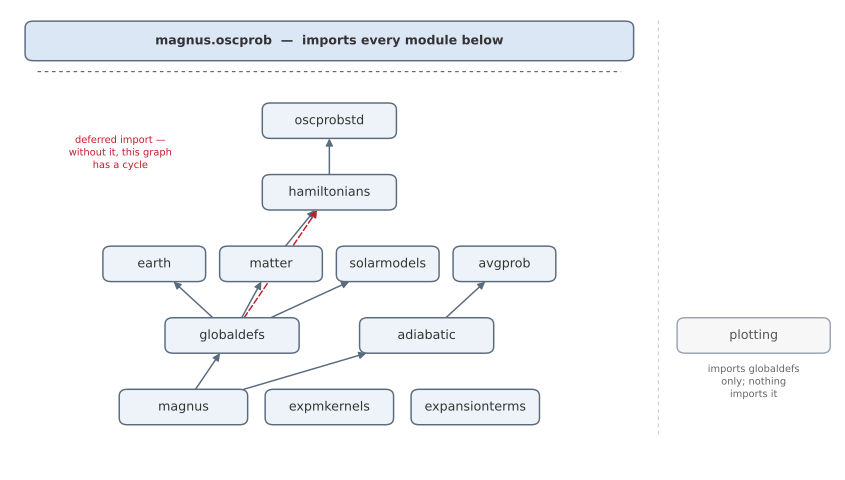
Generated by docs/make_figures.py, which fails rather than draw
this if a module appears in src/magnus/ and not here.
Module |
Responsibility |
|---|---|
|
The Magnus expansion itself: Gauss–Legendre integrators, slab composition, the exactly-unitary matrix exponential |
|
Compiled kernels for the matrix exponential: Cayley–Hamilton at 2x2 and 3x3, a batched Jacobi eigensolver at 4x4 and 5x5 |
|
The Magnus terms derived from the Bernoulli recursion in exact rational arithmetic, at any order (Magnus Expansion Terms to Any Order) |
|
Physical constants, unit conversions, NuFIT parameter sets |
|
Adiabatic transport and the Magnus-patch |
|
PREM density profile, chord and zenith-angle geometry |
|
Tabulated standard solar models, as density and composition profiles
(Standard solar models); imports only |
|
Density profiles, electron number density, \(V_{\rm CC}\) construction, the matter-potential projector |
|
The phase average over an energy spread, and the decohered limit it reduces to |
|
Mixing matrices and vacuum/matter/NSI/LIV Hamiltonians, two to
five flavors ( |
|
Closed-form standard-oscillation counterparts, for validation |
|
The public API, and the only module that imports every other |
|
Pre-packaged figures; imports only |
|
The |
Two consequences of this layout are worth calling out because they are easy to break by accident when adding code:
magnus.magnus(the Magnus-expansion core) imports nothing from the rest of the package at all: it is pure numerical linear algebra on an arbitrary matrix function \(A(t)\), and knows nothing of neutrinos.magnus.hamiltoniansis nearly as self-contained – pure algebra on mixing angles and potentials – with one deliberate exception:hamiltonians4nu/hamiltonians5nuimportmagnus.matterformatter_potential_projector(), because the sterile states’ entry in the matter term has exactly one correct definition and writing it out by hand a second time is what produced a wrong-answer bug in the NSI route. Both are independently unit tested (tests/test_magnus_expansion.py/tests/test_hamiltonians.py) without touchingoscprobat all.One edge in that graph is a deferred import, and it is load-bearing.
globaldefsimportsmagnus.hamiltoniansinside a function rather than at module scope. Hoisting it to the top would close the loopglobaldefs -> hamiltonians -> matter -> globaldefsand the package would stop importing.magnus.adiabaticfollows the same rule: it depends only onmagnus.magnus(for the local Magnus patch), never onoscprob, so it is independently unit tested (tests/test_adiabatic.py) and usable directly on any Hamiltonian function, entirely outside the oscillation-probability API. See Adiabatic + Magnus Hybrid Strategy for its numerical method.magnus.oscprobis the only module that imports everything else. It is where physics scenarios (vacuum/matter/NSI/LIV), environments (constant density/exponential density/Earth/Sun), and the Magnus core are wired together. This is deliberate: it keeps the wiring in one place instead of scattering it across the physics and numerical modules.
adiabatic.py, avgprob.py, cli.py, earth.py,
expansionterms.py, expmkernels.py, globaldefs.py, magnus.py,
matter.py, oscprob.py, oscprobstd.py, plotting.py and
solarmodels.py are flat
sibling files directly under src/magnus/ – there is no subpackage directory
wrapping any of them. Only magnus.hamiltonians is a genuine
subpackage, since it holds one module per flavor count
(hamiltonians2nu.py through hamiltonians5nu.py) plus
hamiltonians_pseudodirac.py for the paired spectra of
Phase-Averaged Probabilities; its __init__.py explicitly imports and
re-exports each one’s public names (no from .module import *).
magnus/__init__.py does the same for the twelve it lists (again, no
wildcard imports) so that import magnus alone makes magnus.earth,
magnus.oscprob, etc. immediately accessible.
plotting.py is the one module outside this dependency picture: it
imports nothing from the rest of the package except
globaldefs (for the flavor constants), and nothing imports it. It is
also the only module needing a dependency beyond NumPy/SciPy/joblib –
Matplotlib, which ships with Magnus and is imported lazily inside the
drawing calls, so import magnus does not pay for it. See
Pre-Packaged Plotting Tools. magnus.oscprob
additionally imports and re-exports oscprobstd.py’s five names (the
closed-form validation counterpart to the wrapper API), so both
magnus.oscprob.osc_prob_3nu_vacuum_std and
magnus.oscprobstd.osc_prob_3nu_vacuum_std work.
The three-layer structure of magnus.oscprob
magnus.oscprob is the largest module (~22,000 lines) because it exposes a
dedicated, explicitly-named function for every combination of
(flavor count) \(\times\) (environment) \(\times\) (BSM
scenario) — roughly 60 combinations. To keep that size from turning into
60 independent copies of the same logic (which is exactly what caused
several of the bugs this package’s test suite now guards against — see
The layer contract: what a wrapper must not do below), every one of those 60 functions is a thin
call into a much smaller set of shared functions. There are three layers:
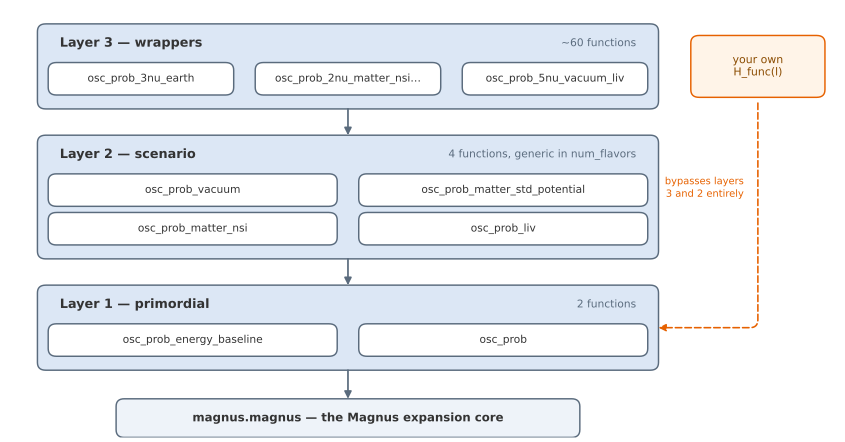
Each layer names a few representative functions; the full signatures are in the API reference, which is where they stay legible.
Layer 1 – primordial. osc_prob is the only function that calls
into the Magnus core. It owns the adaptive-refinement loop (grow
n_slabs/n_tpts_per_slab until two successive levels agree within
rtol/atol, or a cap is hit – note that is an agreement, not a
bound on the error; see What rtol and atol actually control), input validation, logging, and the
~50-line docstring documenting all of the refinement/logging keyword
arguments (see it directly in
osc_prob()). It is also a first-class
public entry point: pass it any callable H_func(l) (or
H_func(enu, l), or a constant matrix) and it works with no wrapper at
all – this is the escape hatch for Hamiltonians the package does not
already know about. osc_prob_energy_baseline sits just above it:
given arrays of energy and L, it builds the right
energy-dependent closure over H_func, decides whether to parallelize
over points (joblib.Parallel) or hand a single call straight to
osc_prob, and carries the warm start logic that seeds each point’s
refinement from the previous point’s converged (n_slabs,
n_tpts_per_slab).
Layer 2 – scenario. osc_prob_vacuum, osc_prob_matter_std_potential,
osc_prob_matter_nsi, and osc_prob_liv are each generic in
num_flavors (2, 3, 4, or 5): they unpack the relevant parameter dict
(via unpack_oscillation_params_from_dict, unpack_nsi_params_from_dict,
unpack_liv_params_from_dict), dispatch to the matching function in
magnus.hamiltonians (e.g. hamiltonian_3nu_matter for
num_flavors=3), build the position-dependent matter potential where
relevant (via magnus.matter.vcc_func_from_rho_func), and call
osc_prob_energy_baseline with the resulting H_func. This is where
“what physics scenario is this” is decided; it is not where “how many
flavors” or “which environment” is decided – those come from the caller
(layer 3) and from rho_func, respectively.
Layer 3 – wrappers. Every osc_prob_{2,3,4,5}nu_{scenario} function
(e.g. osc_prob_3nu_matter_constant_density,
osc_prob_4nu_earth_nsi, osc_prob_2nu_vacuum_liv) exists purely so
that users get explicit, autocomplete-and-docs-friendly parameter names
(s12, eps_em, rho, …) instead of having to build
osc_params/nsi_params/liv_params dictionaries by hand. Its
entire job is: validate/repackage its named parameters into the right
dict(s), and forward everything else to the matching layer-2 function.
osc_prob_earth/osc_prob_sun are a deliberate, bounded exception:
because they need to build a PREM-based (or solar-density-based)
VCC_func and choose between the 2/3/4/5nu Hamiltonians themselves,
they sit one level below the per-flavor osc_prob_{N}nu_earth/
osc_prob_{N}nu_sun wrappers and forward a curated subset of
parameters positionally into _osc_prob_with_potential, rather than
by name through **kwargs like every other wrapper.
The layer contract: what a wrapper must not do
Every wrapper function ends in **kwargs and must not redeclare
any of the refinement/logging keyword arguments that layers 1-2 own:
magnus_exp_order, n_jobs, integration_method, rtol, atol,
growth_factor_n_slabs, growth_factor_n_tpts_per_slab, max_num_loops,
min_n_slabs, max_n_slabs, min_n_tpts_per_slab, max_n_tpts_per_slab,
new_recursion_limit, return_evolution_operator, average
This is not a style preference; it is a correctness requirement, and the
history of this package shows what happens when it is violated. Before
the refactor that introduced this contract (internally referred to as
“G1”), every wrapper declared its own copy of these ~15 parameters with
its own defaults. That duplication is exactly what let several bugs hide
for a long time: a wrapper with a silently different default tolerance
than its siblings, a wrapper missing nubar entirely, a wrapper with
an inconsistent validation bound. Fixing a default meant remembering to
fix it in ~60 places; inevitably, some were missed.
Two permanent tests in tests/test_oscprob.py enforce this contract in
CI, and will fail if it is ever violated again:
test_no_wrapper_redeclares_standard_refinement_kwargs— inspects everyosc_prob_{2,3,4,5}nu_*function’s signature viainspect.signature()and fails if any of the 15 names above appear in it.test_nubar_present_across_all_flavor_counts_in_matter_families— fails if a matter/NSI/LIV wrapper family exposesnubarfor some flavor counts but not others.
If you are adding a wrapper and find yourself typing
rtol: Optional[float] = 1.e-3 in its signature, that is a signal you
are working at the wrong layer: forward it through **kwargs instead.
return_evolution_operator and average follow the same rule, and show
why the rule pays: declared by osc_prob_energy_baseline and the generic
entry points (the operator keyword by the core as well), every one of the sixty
osc_prob_{N}nu_* wrappers got them for free through **kwargs. One
consequence to know about: the passthrough guard reads its accepted keywords
off those signatures, so a keyword that only the batching layer declares would
pass the guard on osc_prob and fail deep inside the engine; osc_prob
therefore refuses average and cumulative by name. The keyword is honored by the core and
the batching layer; the specialized engines answer with probabilities only,
so the entry points disable them for the call (through the same
_engine_probe mechanism the cross-check uses) and the general ladder
answers.
Data flow: how the Hamiltonian and potential are built
The matter potential and the Hamiltonian are built once per call (not once per slab), then passed down as a single callable:
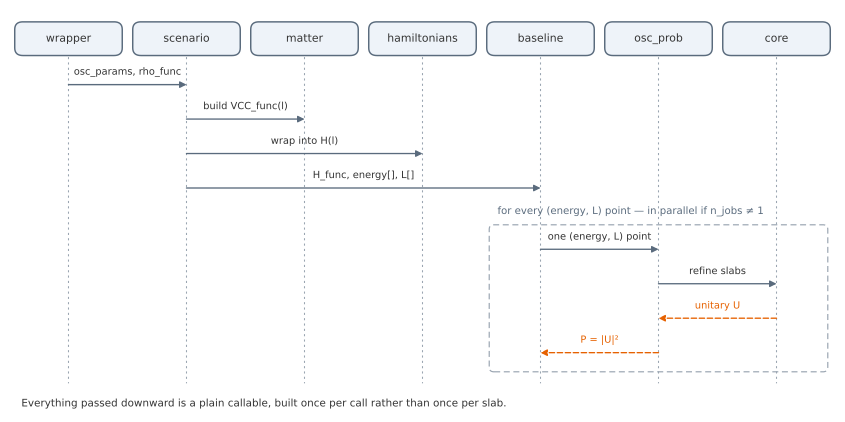
The potential and the Hamiltonian are built once per call, not once per slab, and everything handed downward stays a plain callable.
Every intermediate object here is a plain Python callable
(VCC_func: l -> float, H_func: l -> ndarray); nothing is
precomputed on a grid before reaching osc_prob, which is what lets
magnus.magnus.probe_eval_mode() decide, once, whether H_func
can be evaluated on a vectorized array of positions (silent
vectorization – see Methodology) or must be called one position
at a time.
How to add your own wrapper
Suppose you want to add support for a new environment, e.g. a
user-supplied radial density profile for 3-flavor NSI oscillations,
osc_prob_3nu_matter_nsi_custom_density. The existing
osc_prob_3nu_matter_nsi_exp_density (in magnus.oscprob) is the
closest sibling to copy from. The recipe:
Pick the right layer-2 function. You are adding an environment (a new
rho_func), not a new physics scenario, so you call the existingosc_prob_matter_nsi— you do not need to touchmagnus.hamiltoniansor the Magnus core at all.Name only the parameters specific to your scenario. Your function’s signature should have: the standard positional physics inputs (
energy,L), whatever parametrizes your density profile (e.g. adensity_func: Callablethe user supplies directly), the standard oscillation parameters for 3 flavors (s12, s23, s13, dCP, D21, D31, allOptional[float] = None), the standard NSI parameters (eps_ee, eps_em, ...), the standard trailing parameters every wrapper has (ratio_number_neutrons_to_protons,electron_fraction,nubar,nu_i,nu_f,validate_input,save_log,filename_log,file_log,close_file_log_upon_exit,verbose), and end with**kwargs.Do not name any of the 15 refinement/logging kwargs listed in The layer contract: what a wrapper must not do above. They flow through
**kwargsautomatically. This is what the two permanent guard tests check.Write the body as a single call down, packaging your named parameters into the
osc_params/nsi_paramsdicts thatosc_prob_matter_nsiexpects:def osc_prob_3nu_matter_nsi_custom_density( energy, L, density_func, s12=None, s23=None, s13=None, dCP=None, D21=None, D31=None, eps_ee=0.0, eps_em=0.0j, eps_et=0.0j, eps_mm=0.0, eps_mt=0.0j, eps_tt=0.0, ratio_number_neutrons_to_protons=1.0, electron_fraction=0.5, nubar=False, nu_i=None, nu_f=None, validate_input=True, save_log=False, filename_log='./out.log', file_log=None, close_file_log_upon_exit=True, verbose=0, angles='sin', **kwargs ): r"""Compute the 3nu NSI oscillation probability for a user-supplied radial matter density profile. .. versionadded:: <the next release> """ return osc_prob_matter_nsi( num_flavors=3, rho_func=density_func, energy=energy, L=L, osc_params={'s12': s12, 's23': s23, 's13': s13, 'dCP': dCP, 'D21': D21, 'D31': D31}, nsi_params={'eps_ee': eps_ee, 'eps_em': eps_em, 'eps_et': eps_et, 'eps_mm': eps_mm, 'eps_mt': eps_mt, 'eps_tt': eps_tt}, ratio_number_neutrons_to_protons=ratio_number_neutrons_to_protons, electron_fraction=electron_fraction, nubar=nubar, nu_i=nu_i, nu_f=nu_f, validate_input=validate_input, save_log=save_log, filename_log=filename_log, file_log=file_log, close_file_log_upon_exit=close_file_log_upon_exit, verbose=verbose, angles=angles, **kwargs )
anglesis worth a word: it is a pure pass-through, and every wrapper in the package forwards it unexamined to the layer below, which is where the four conventions are interpreted. A wrapper that accepts it and forgets to forward it compiles, documents itself correctly and silently ignores the caller – four functions in this package did exactly that before a check was written for it, so the family-consistency tests below now assert that anything takinganglesalso reads it.Add it to the family-consistency tests.
test_oscprob.pyparametrizes several checks over “every osc_prob wrapper family” by name pattern; add your new function’s family prefix alongside its 3 siblings (2nu/4nu/5nu, if you are adding all four) so the same unitarity/nubar-sensitivity/API-shape checks cover it automatically instead of needing bespoke tests.Run the two guard tests described in The layer contract: what a wrapper must not do before opening a pull request:
pytest tests/test_oscprob.py -k "redeclares_standard or nubar_present" -v
If your new function needs genuinely new physics (not just a new
environment) – e.g. a Hamiltonian term that does not fit
vacuum/matter/NSI/LIV – then the right layer to extend is layer 2: add
a new osc_prob_<scenario> function generic in num_flavors,
following the pattern of osc_prob_liv, and a matching
hamiltonian_<n>nu_<scenario> in magnus.hamiltonians for each
flavor count you support. Only then add layer-3 wrappers on top of it.
Where things live: a quick lookup
If you need to change… |
…look in |
|---|---|
A default tolerance, the refinement/adaptive-slab-growth logic, or anything every scenario shares |
|
How a physics scenario’s Hamiltonian is assembled from mixing angles/NSI epsilons/LIV coefficients |
|
The actual matrix form of a Hamiltonian (mixing matrix, vacuum term, matter term, NSI term, LIV term) |
|
A named parameter exposed to end users for one (flavor count, environment, scenario) combination |
the matching |
The Magnus term recursion, the Gauss-Legendre integrators, or the matrix exponential itself |
|
The PREM density profile or Earth chord/zenith geometry |
|
A generic density profile, electron number density, or the \(V_{CC}\) potential construction |
|
A physical constant, unit conversion, or a predefined oscillation parameter set (e.g. NuFIT 6.0) |
|